


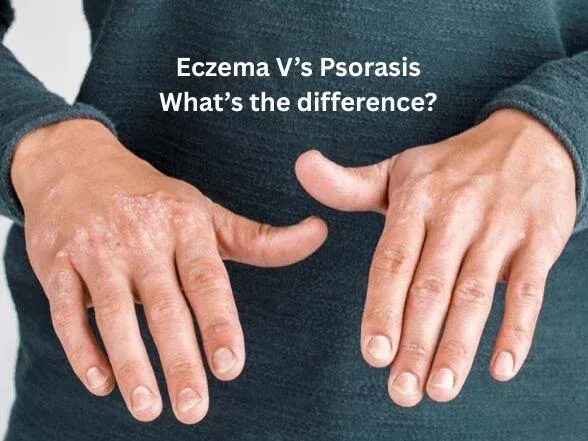
The main difference between psoriasis and eczema lies in texture and location. Psoriasis produces thick, raised, well-defined red or purplish plaques covered in silvery scales, typically on the outer surfaces of joints like elbows and knees. Eczema presents as thin, poorly defined, itchy rashes that ooze or crust, almost always settling into the bends of joints.
A red, irritated patch of skin is easy to misread. Psoriasis and eczema look similar at a glance, and both involve an overactive immune response that disrupts the skin barrier. Yet the two conditions have distinct biological mechanisms, trigger profiles, and treatment pathways. Misidentifying one for the other can delay meaningful relief for months.
This guide walks through the precise clinical differences dermatologists use to distinguish plaque psoriasis from atopic dermatitis, a practical self-audit checklist, and the secondary symptoms that help confirm which condition you are actually dealing with.
How Psoriasis and Eczema Differ at a Cellular Level
Both psoriasis and eczema originate in immune system dysfunction, but they diverge sharply at the cellular level.
In plaque psoriasis, T-cells mistakenly attack healthy skin tissue, triggering keratinocytes (the skin’s surface cells) to reproduce at roughly ten times the normal rate. This accelerated cell turnover stacks layers of immature skin cells on the surface, producing the characteristic thick, silvery plaques. The National Psoriasis Foundation notes that psoriasis affects approximately 3% of the global adult population.
Atopic dermatitis, the most common form of eczema, involves a deficiency in filaggrin, a structural protein that holds the skin barrier together. When the skin barrier breaks down, allergens and irritants penetrate more easily, triggering a cascade of inflammatory responses driven by cytokines interleukin-4 (IL-4) and interleukin-13 (IL-13). The result is a leaky, hyperreactive skin surface that weeps, crusts, and itches intensely.
These different biological mechanisms explain why the two conditions feel and look so different on the skin’s surface.

The Core Diagnostic Differential Matrix
Use the breakdown below to analyze the specific characteristics of your rash across the primary diagnostic markers used by dermatologists:
| Clinical Marker | Psoriasis (Plaque Psoriasis) | Eczema (Atopic Dermatitis) |
| Primary Sensation | Stinging, burning, or painful tightness | Intense, frantic, unbearable itching |
| Texture and Border | Thick, raised, leather-like plaques with sharp, well-defined borders | Thin, dry, bumpy, or flaky patches with blurry, blending edges |
| Flaking Style | Thick, prominent silvery-white scales that shed easily | Fine flaking, rough gooseflesh bumps, or cracked skin that oozes and crusts |
| Primary Locations | Extensor surfaces (outside of elbows and knees), scalp, lower back, nails | Flexor surfaces (crook of elbows, behind knees), face, neck, wrists |
| On Darker Skin Tones | Appears purple, plum, or dark brown with distinctly silver-gray scales | Appears dark brown, purple, or ashen grey; prone to post-inflammatory hyperpigmentation |
| Age of Onset | Most commonly develops between ages 15 and 35 | Typically develops in early childhood or infancy |
Why Location Is the Single Most Reliable First Signal
The joint geography rule is the fastest way to narrow down a diagnosis before seeing a physician. Eczema gravitates toward flexor surfaces, the soft folding creases of the body where skin rubs against skin. Psoriasis gravitates toward extensor surfaces, the bony, exposed outcroppings of joints.
This pattern holds across most cases of plaque psoriasis and atopic dermatitis. It exists because the two conditions respond differently to friction, heat, and moisture. The warm, moist environment of skin folds aggravates atopic dermatitis, while psoriasis is commonly triggered by the Koebner phenomenon, where physical trauma to skin (including pressure on bony joints) provokes new plaques.
The 4-Step Sensation and Location Self-Audit
If you are unsure which condition you are dealing with, work through this sequential checklist to narrow down the clinical markers before booking an appointment with a board-certified dermatologist.
Step 1: Map the Joint Geography
Look closely at where the rash clusters around your joints. Inflammation settling directly into soft, folding creases (the inside bend of your elbow or the hollow behind your knee) scores toward eczema. Inflammation forming on hard, bony outcroppings (the point of your elbow or the front of your kneecap) scores toward psoriasis.
Step 2: Monitor the Nocturnal Scratch Reflex
Pay attention to how the rash behaves at night. Itching so intense it wakes you from sleep, or forces you to scratch until the skin breaks and oozes clear fluid, aligns with atopic dermatitis. An area that feels sore, hot, or resembles a mild sunburn when touched points toward psoriasis.
Step 3: Gently Examine a Scale (The Auspitz Test)
Look at the flaking skin under strong light. Thin, dry flakes that resemble peeling skin after a sunburn suggest eczema. Thick, layered scales that, when peeled away, reveal tiny pinpoint bleeding drops underneath indicate the Auspitz sign, a classic clinical marker of plaque psoriasis recognized in dermatology literature.
Step 4: Inspect Your Finger and Toenails
Examine the surface of your nails carefully. Eczema rarely impacts the nail bed itself, though severe hand eczema can cause ridges along the nail surface. Nails showing tiny pinpoint dents (nail pitting), lifting away from the nail bed (onycholysis), or displaying a yellowish-brown discoloration described as an “oil drop” sign strongly indicate systemic psoriasis. According to the American Academy of Dermatology, nail changes appear in up to 50% of people with psoriasis and up to 80% of those who develop psoriatic arthritis.
Psoriasis and Eczema on Darker Skin Tones: What Changes
Medical education has historically underrepresented how inflammatory skin conditions present on medium and darker skin tones, which leads to delayed or missed diagnoses. On deeper complexions:
- Psoriatic plaques often appear plum, dark brown, or purple rather than the classic bright red, while the silvery-white scale remains one of the most consistent identifiers regardless of skin tone.
- Eczema patches may appear ashen gray, dark brown, or hyperpigmented rather than pink or red. The itching, oozing, and crusting characteristics remain consistent.
- Post-inflammatory hyperpigmentation (PIH) is more pronounced in atopic dermatitis on darker skin, leaving dark patches behind even after the active inflammation resolves.
Dermatologists recommend that individuals with darker skin tones prioritize texture and sensation over color when performing any self-assessment.
When to See a Dermatologist
Self-assessment has real limits. Several conditions mimic both psoriasis and eczema, including seborrheic dermatitis, contact dermatitis, pityriasis rosea, and in rare cases, cutaneous T-cell lymphoma. A board-certified dermatologist can confirm a diagnosis through:
- Visual clinical examination using the diagnostic criteria above
- Dermoscopy (a magnified skin surface examination)
- Skin biopsy, when the diagnosis remains unclear
Early, accurate diagnosis matters because the treatment pathways differ significantly. Atopic dermatitis is commonly treated with topical corticosteroids, calcineurin inhibitors, and newer biologics like dupilumab (Dupixent), which targets the IL-4 and IL-13 pathways. Plaque psoriasis is treated with topical corticosteroids, vitamin D analogues, phototherapy, and biologics like secukinumab (Cosentyx) or ixekizumab (Taltz), which target the IL-17 pathway.
Using a psoriasis treatment on eczema, or vice versa, can worsen symptoms or trigger new flares.
The Bottom Line: Which Condition Do You Have?
Psoriasis and eczema share a surface-level similarity, an immune system overreaction that shows up on your skin. But the two conditions diverge in almost every clinically meaningful way. Psoriasis builds thick, defined plaques on bony joint surfaces and burns. Eczema produces thin, blurry-edged rashes in the warm folds of the body and itches relentlessly. Just as identifying skin conditions early is essential for proper treatment, learning what a cavity looks like can help you spot early signs of dental decay before it worsens.
The 4-step self-audit above gives you a structured starting point. Take note of your observations before your appointment. The more specific the information you bring to your dermatologist, the faster an accurate diagnosis and effective treatment plan can follow.
Frequently Asked Questions
Can you have both psoriasis and eczema at the same time?
Yes. Having both conditions simultaneously is uncommon but possible. Each condition can appear on different parts of the body, which is one reason accurate diagnosis requires a full skin examination by a dermatologist rather than isolated self-assessment.
Is psoriasis or eczema more itchy?
Atopic dermatitis (eczema) typically causes more intense and relentless itching than plaque psoriasis. Psoriasis more often produces a burning or stinging sensation rather than a frantic itch, though some individuals experience itching with psoriasis as well.
Do psoriasis and eczema have the same triggers?
Some triggers overlap, including stress, certain infections, and dry weather. However, atopic dermatitis is frequently triggered by allergens (dust mites, pet dander, certain foods), while plaque psoriasis is more commonly triggered by physical skin trauma, streptococcal infections, and certain medications such as lithium and beta-blockers.
Can psoriasis or eczema be cured permanently?
Neither condition has a permanent cure as of 2025. Both are chronic inflammatory conditions managed with treatment rather than eliminated. Many patients achieve extended periods of remission with appropriate therapy.
Is the Auspitz sign a reliable home test for psoriasis?
The Auspitz sign (pinpoint bleeding after removing a scale) is a recognized clinical indicator of plaque psoriasis in dermatology. However, it should not be self-induced aggressively at home, as breaking the skin carries infection risk. Observing it gently under good lighting is sufficient for self-assessment purposes.
At what age does psoriasis typically develop compared to eczema?
Atopic dermatitis most commonly develops in infancy or early childhood, with many cases improving by adulthood. Plaque psoriasis has two common onset peaks: one between ages 15 and 35 (early-onset) and one between ages 50 and 60 (late-onset).
Continue exploring expert-written articles on everyday health topics by visiting our health knowledge center.
If your foot symptoms do not match the Tinea Pedis profile above, it is worth ruling out a broader inflammatory skin condition; our guide on psoriasis vs. eczema breaks down the same texture-and-location diagnostic approach for skin elsewhere on the body.
Acne is not the only chronic skin condition that benefits from an accurate diagnosis before treatment; the same is true for psoriasis and eczema, which are frequently mistaken for each other and treated incorrectly as a result.